
Google Gadgets and Web Widgets on Your Desktop with Screenlets
With the newest version of Screenlets, 0.1, you can now run not only Python Screenlets but also Google Gadgets, other web widgets, and web applications. If you want to get started with Screenlets, I’ve previously written a guide about installing and configuring it: OS X-Like Widgets with Screenlets on Ubuntu.
Start the Screenlets Manager (Applications->Accessories->Screenlets). If you
get an error about Gtkmozembed, you need to fix this first by installing the
python-gnome2-extras package:
sudo apt-get install python-gnome2-extras
In Screenlets Manager, click the Install button. From the drop-down box you
can select to install a Screenlet, SuperKaramba Theme, Web Widget, or Web
Application. I won’t go into SuperKaramba themes or web applications today, so
let’s get to installing a web widget.
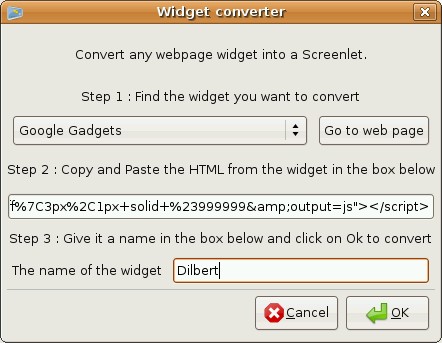
After selecting web widgets, the Widget Converter dialog will open, and give
even more choices: Google Gadgets, Yourminis Widgets, Spring Widgets, and
Widgetbox. Select the type of widget you want and click the Go to web page
button to go the widget directory for that type of widget.
I selected to install a Google Gadget. In Google’s directory, look for the Get
the Code button for the gadget you want. This will give you the code you need
to paste into the dialog.
Give your widget a name, and you should be ready to click OK. Hopefully you
will see an alert saying Widget was successfully converted. Now you should be
able to start your widget just like a normal Screenlet.

The integration Screenlets now has with online widgets increases the usefulness a lot, there are sure a lot more Google Gadgets than Screenlets. My only issue at the moment is that there is no way to resize the occasional widgets that render smaller or larger than I want.
Great job to the developers of Screenlets!
Archived Comments
STi
Nice going but can’t really get it going with the google agenda widget.
Anybody having any luck ?
shell
i am use 64bit ubuntu 8.04, how to fix it????????
$ screenlets-manager
Traceback (most recent call last):
File 「/usr/share/screenlets-manager/screenlets-manager.py�, line 28, in
import screenlets
File 「/usr/lib/python2.5/site-packages/screenlets/__init__.py�, line
75
SyntaxError: Non-ASCII character 『\xc3′ in file
/usr/lib/python2.5/site-packages/screenlets/__init__.py on line 75, but no
encoding declared; see http://www.python.org/peps/pep-0263.html for details
Anatoly
To shell:
I had the same problem, you need to install this package: python-chardet
sudo aptitude python-chardet
Thanks for the guide, Tom..
ericmoritz
Is anyone else seeing the color gray as transparent? Seems like there’s some masking going on with that color that’s messing things up.
Mahyar
I don’t get it. When I click ‘Install’ in Screenlets Manager, I don’t get this ‘Widget converter’. Instead, I just get a new Nautilus window asking me to pick a file.
Am I doing something wrong?
German
Mahyar, make sure you use the version from the PPA, I had the same problem because I used the one found in gutsy backports
dan l
Awesome.
Pegasus7
@whise, wow, what a complete ripoff of amnesty generator - even up to the ui. Least you can do is credit amnestywidgets.com for the “inspiration”
stansford
Hi,
I have the following error even after installing python-chardet as you advised
above:
Traceback (most recent call last):
File “/usr/share/screenlets-manager/screenlets-manager.py”, line 28, in
import screenlets
File “/usr/lib/python2.5/site-packages/screenlets/__init__.py”, line 75
SyntaxError: Non-ASCII character ‘\xc3’ in file
/usr/lib/python2.5/site-packages/screenlets/__init__.py on line 75, but no
encoding declared; see http://www.python.org/peps/pep-0263.html for details
Error in sys.excepthook:
Traceback (most recent call last):
File “/usr/lib/python2.5/site-packages/apport_python_hook.py”, line 78, in
apport_excepthook
report_file = open(pr_filename, ‘wt’)
IOError: [Errno 13] Permission denied:
‘/var/crash/_usr_share_screenlets-manager_screenlets-manager.py.1000.crash’
Original exception was:
Traceback (most recent call last):
File “/usr/share/screenlets-manager/screenlets-manager.py”, line 28, in
import screenlets
File “/usr/lib/python2.5/site-packages/screenlets/__init__.py”, line 75
SyntaxError: Non-ASCII character ‘\xc3’ in file
/usr/lib/python2.5/site-packages/screenlets/__init__.py on line 75, but no
encoding declared; see http://www.python.org/peps/pep-0263.html for details
Any further ideas how to fix this?
thanks
Anonymous
Hi,
I tried to install google calendar widget in screenlets, it coverts and runs,
but it doesn’t show my events and agenda in the screenlets window.I entered the
xml/ical address of my google calendar! any idea?
thanks
Anonymous
I’m having the same issue with the google calendar gadget. I entered my
calendar’s private address on the gadget webpage and my calendar information
displayed perfectly. I “got the code” and saw that my calendar address was
embedded in the script for the gadget. I pasted the code into the gadgdet
conversion window in screenlets and the conversion was successful. When I run
the new screenlet, only a blank calendar appears with no events.
If anyone has gotten the google calendar gadget to work with screenlets, your
help would be appreciated!
James Su
Now you can use Google Gadgets for Linux to run both Goolge Desktop Gadgets and iGoogle Gadgets on your Linux desktop, without any extra converting steps.
surya
great post.. thanks
pete
Hi, I follow the guide and paste the code, it says “conversion successful” yet when I run the widget, it always shows a grey box with a rounded border with text instead of the app :(
Swamy
This is a wonderfulNow you can use Google Gadgets for Linux to run both Goolge Desktop Gadgets and iGoogle Gadgets on your Linux desktop, without any extra converting steps.
kurt
this doesn’t work. I’ve tried it multiple times in ubuntu 10.04.
the problem is that, once converted, the screenlets don’t give you access to
configure the login parameters for the gadgets. I’ve tried installing google
mail and calendar gadgets so I could have what I used to use on a windows
desktop.
It doesn’t provide this so it just displays a gray textbox.
Have our good friends at lifehacker actually tried any of these to confirm they’re working?
Kurt
Joris
Hi,
nice post!
The last line in your explanation mentions the problem of not being able to resize the widget. I’m having a similar issue. One of the web widgets that I get from igoogle renders too small.
Is there any solution that you are aware of?
Many thanks!
Whise
hello , im the developer … nice guide :)